
Gate valves and butterfly valves are both used to control media flow, but they differ significantly in their design, performance, and ideal applications. While they serve the similar purpose of allowing or blocking flow, understanding their key distinctions is critical for selecting the right valve for your system and avoiding costly errors.
The primary difference is their mechanism. A gate valve uses a solid gate that moves vertically to block flow, offering an unobstructed path when open. A butterfly valve uses a rotating disc to control flow, which offers speed and compactness but means the disc is always present in the flow path.
| Parameter | Gate Valve | Butterfly Valve |
|---|---|---|
| Primary Function | ✅ On/Off Isolation ❌ Not for throttling | ✅ Throttling & On/Off Control |
| Pressure Loss | ✅ Very Low (Unobstructed flow) | ⚠️ Low, but disc is always in flow |
| Operating Speed | ⚠️ Slow (30-60 seconds) | ✅ Fast (<5 seconds) |
| Weight | ⚠️ Significantly Heavier | ✅ Up to 50% Lighter |
| Installation Space | ⚠️ Large Footprint | ✅ Extremely Compact |
| Temperature Limit | ✅ High (up to 550°C) | ⚠️ Lower (up to 200°C) |
| Sealing Ability | ✅ Excellent (True zero-leakage) | ⚠️ Good (Risk of minor leakage) |
| Cost (Large Sizes) | ⚠️ More Expensive | ✅ More Economical |
| Water Hammer Risk | ⚠️ Higher Risk | ✅ Lower Risk |
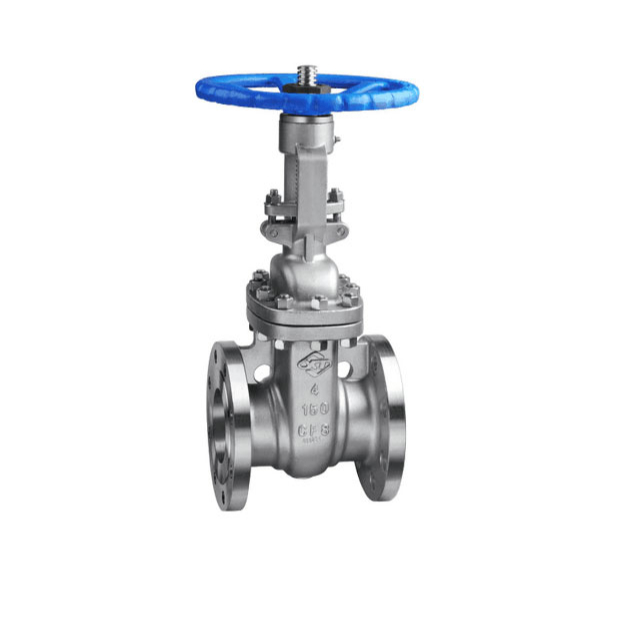

What is a Gate Valve?
A gate valve is a type of valve that uses a flat or wedge-shaped gate that moves up and down to start or stop the flow of fluid.
When the valve is fully open, the gate is completely out of the flow path, providing minimal resistance and a straight-through, full-bore flow. When the valve is closed, the gate is lowered into the flow path, blocking the passage completely. Gate valves are typically used for on/off control rather than throttling. Throttling with a gate valve can cause vibration and damage to the gate and seat.
Key Characteristics:
- Unobstructed Flow: Provides minimal pressure loss when fully open.
- Tight Sealing: Resilient seated designs can offer zero-leakage seals.
- High-Temperature Capability: Can be designed to handle temperatures up to 550∘C.
- Slow Operation: Requires multiple turns and 30-60 seconds to open or close fully.
What is a Butterfly Valve?
A butterfly valve is a quarter-turn valve used to regulate, start, or stop flow. It consists of a circular disc mounted on a rotating shaft.
When the valve is fully closed, the disc blocks the passageway. When fully open, the disc is rotated a quarter turn (90°) to allow fluid to pass through. Intermediate positions can be used to throttle or regulate flow. Their design makes them quick to operate but results in the disc always being a minor obstruction in the flow.
Key Characteristics:
- Compact & Lightweight: In an 18″ Class 150 size, a butterfly valve can be 50% lighter than a gate valve.
- Fast Operation: Can be fully opened or closed in under 5 seconds.
- Throttling Capable: Suitable for applications requiring flow regulation.
- Cost-Effective: Generally a more economical choice, especially in large pipe diameters.
Gate Valve vs. Butterfly Valve: A Detailed Comparison
To make an informed decision, it’s best to compare the valves across key operational parameters. From our experience in specifying valves for thousands of projects, these are the most critical differences.
Application Guide: When to Choose Each Valve
✅ Choose a Butterfly Valve for:
- Space-Constrained Sites: Ideal for offshore platforms, compact processing plants, and areas where installation space is tight.
- Throttling Applications: Excellent for water treatment, cooling systems, and air handling where you need to regulate flow.
- Emergency Shutoffs: Where fast response is critical, their sub-5-second operation is a major advantage.
- Large-Diameter Pipes: Significant cost and weight savings make them the preferred choice for pipes over DN200.
- Systems Prone to Water Hammer: Their equal percentage flow characteristics help reduce pressure surges during closing.
✅ Choose a Gate Valve for:
- High-Temperature/Pressure Systems: The best choice for steam, thermal oil, and other high-energy applications.
- Zero-Leakage Requirements: When a tight, positive shutoff is non-negotiable, such as in chemical processing or gas pipelines.
- Full-Bore Flow Needs: For applications like pigging or where minimizing pressure drop is the top priority (e.g., main water distribution lines).
- Infrequent Operation: Best suited for isolation points in a system that are left fully open or fully closed for long periods.
Common Maintenance Issues and Prevention
Based on our field experience, both valves have distinct failure modes that buyers should be aware of.
- Gate Valve Risks: A common issue, especially in geothermal or high-temperature service, is stem seizure. The high temperatures can cause the stem packing to bind. To prevent this, we advise using flexible wedge designs and performing regular graphite packing replacement.
- Butterfly Valve Risks: In applications with abrasive media like slurries, the disc can suffer from erosion. For systems requiring frequent throttling, the seat can experience accelerated wear. We recommend using hard-faced coatings on the disc for abrasive services and planning for seat replacement (e.g., EPDM/PTFE) every 3-5 years in high-cycle applications.
Gate Valve vs Butterfly Valve FAQs
Which characteristic is an advantage of a butterfly valve as compared to a gate valve?
One significant advantage of a butterfly valve over a gate valve is its compact and lightweight design.
Butterfly valves take up less space and are lighter, making them easier to install and operate, especially in large-diameter pipelines.
This advantage makes butterfly valves ideal for applications where space constraints and ease of operation are important considerations.
What is the difference between a butterfly valve and an angle valve?
The primary difference between a butterfly valve and an angle valve lies in their design and function.
A butterfly valve has a rotating disc that controls the flow, providing quick shut-off and flow regulation.
An angle valve, on the other hand, is designed with a 90-degree turn in the flow path and typically uses a globe or ball mechanism to control the flow.
Angle valves are commonly used in plumbing applications to control the flow of water to appliances like toilets and sinks.
While butterfly valves are generally used in larger pipeline systems for their efficiency and ease of use, angle valves are used in applications requiring precise flow control in compact spaces.
What is the difference between a gate valve and a control valve?
Gate valves and control valves differ mainly in their function and design. A gate valve is primarily used for on/off control, allowing for a full flow or complete shut-off of the fluid.
It is not suitable for flow regulation due to its design.
A control valve, on the other hand, is specifically designed to regulate the flow and pressure of fluid within a system.
Control valves use various mechanisms, such as a globe, butterfly, or ball design, to precisely modulate the flow rate and pressure based on the requirements of the process.
Control valves are essential in applications where maintaining specific flow conditions is critical.
What is the difference between a butterfly valve and a check valve?
A butterfly valve and a check valve serve different purposes within a piping system. A butterfly valve is a flow control device that can start, stop, and regulate the flow of fluid.
It uses a rotating disc to open or close the valve.
A check valve, however, is a one-way valve designed to prevent backflow in the system.
Check valves automatically open with the forward flow and close against the reverse flow, ensuring that fluid flows in only one direction.
While butterfly valves are manually or mechanically operated to control flow, check valves operate based on the direction of flow without manual intervention.
What is the main advantage of a butterfly valve?
The main advantage of a butterfly valve is its compact and lightweight design, which allows for easy installation and operation, especially in large-diameter pipes.
Additionally, butterfly valves offer low-pressure drop and quick operation, making them suitable for applications requiring frequent opening and closing.
Their ability to throttle flow also adds to their versatility in various industrial applications.
What is the main use of the butterfly valve?
The primary use of a butterfly valve is to regulate, start, and stop the flow of fluid in a pipeline.
They are widely used in various industries, including water treatment, chemical processing, and HVAC systems, due to their efficient operation, compact size, and ability to handle large volumes of fluid with minimal pressure drop.
What is a gate valve used for?
The primary use of a butterfly valve is to regulate, start, and stop the flow of fluid in a pipeline.
They are widely used in various industries, including water treatment, chemical processing, and HVAC systems, due to their efficient operation, compact size, and ability to handle large volumes of fluid with minimal pressure drop.
Gate Valve and Butterfly Valve Suppliers in China
Xintai Valve is one of the leading global butterfly and gate valve suppliers in China with a global clientele.
Their portfolio encompasses six categories and thousands of varieties, such as globe, ball, check, butterfly, air/oxygen control valves, and more.
Furthermore, they design and manufacture high-quality casting balls and gate globe check wedge valves for various applications.


