
Choosing between a basket strainer and a Y strainer comes down to how much debris your system handles and how easily you want to maintain your pipeline strainer selection.
That simple idea guides the entire comparison because these two devices may look similar, yet they serve different roles depending on flow conditions, particle levels, and cleaning needs.
What a Basket Strainer Does Best
The basket strainer is designed to catch larger amounts of debris while keeping the flow steady and the pressure drop low.
This makes it a top choice in systems where cleanliness is critical, especially in liquid pipelines that move water, fuel, oil, or chemicals.
Its internal basket has more surface area than most other strainer types, which means it can hold more contaminants before needing cleaning.
What makes the basket strainer especially practical is its accessibility.
Since the basket is positioned vertically, operators can lift it out from the top without disconnecting the line.
This reduces downtime and makes the cleaning process more straightforward in applications that cannot afford interruptions.
Industries such as chemical processing, water treatment, oil refining, and HVAC systems use basket strainers because they slow down clogging, protect pumps and valves, and maintain cleaner flow.
In facilities dealing with contaminated or unfiltered liquid, the basket strainer is usually the more dependable option.
Where the Y Strainer Excels
The Y strainer gets its name from its shape, which allows it to fit into both horizontal and vertical pipelines.
It is compact and simple, making it useful for systems with limited space or low contamination levels.
While it can handle liquid service, the Y strainer is widely used in steam, gas, and air pipelines due to its smaller size and ability to operate at high pressure and temperature.
Its screen capacity is not as large as a basket strainer, but what it lacks in depth it makes up for in versatility.
The Y strainer is perfect when continuous protection is needed, but the debris load is light.
Industrial facilities use Y strainers to safeguard traps, regulators, valves, and meters from small particles that could compromise performance.
Because most Y strainer designs include a blow-off or drain connection, operators can flush out collected debris without removing the screen.
This makes cleaning easier in systems where maintenance time must be minimized.
THREAD Y STRAINER
Reliable particle filtration with precision-threaded connections for efficient pipeline protection.
Explore Product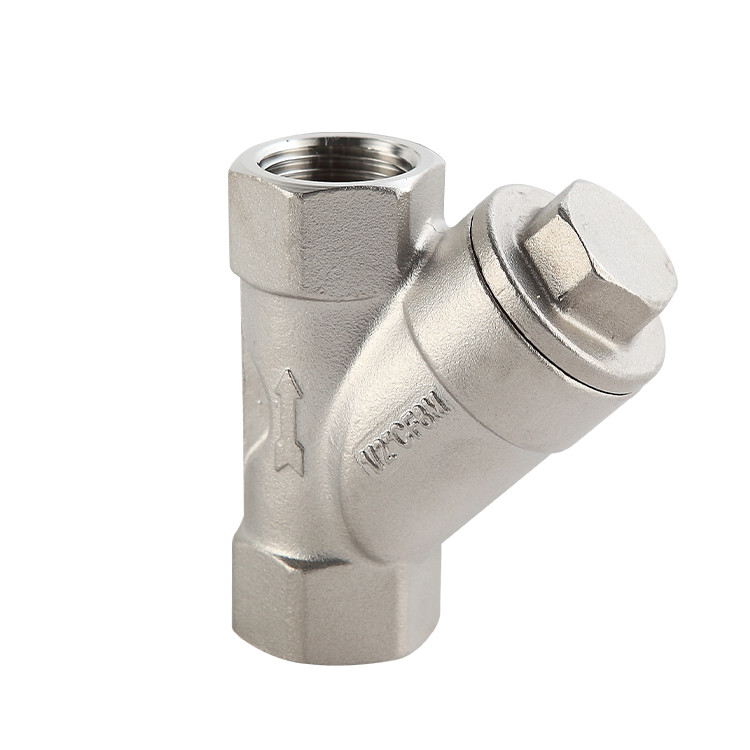
Understanding the Strainer Difference
Even though both strainers protect equipment and improve reliability, the strainer difference comes down to key performance considerations that affect installation and long-term use.
Each one shines in a different type of service, which is why choosing correctly matters for energy efficiency and operating costs.
Below is a clear table comparing the two so you can match each strainer to the right application.
Basket Strainer vs Y Strainer: Key Differences
| Feature | Basket Strainer | Y Strainer |
| Best For | Heavy debris in liquid systems | Light debris in liquid, steam, or gas |
| Screen Capacity | High surface area and holding volume | Smaller surface area |
| Maintenance Access | Easy top removal for cleaning | Requires screen removal unless blow-down is used |
| Installation Orientation | Horizontal only | Horizontal or vertical |
| Pressure Drop | Lower due to a larger filtration area | Higher due to a smaller screen |
| Typical Uses | Water plants, oil systems, and chemical pipelines | Steam lines, compressed air, and gas systems |
| Cost | Higher initial cost | Lower initial cost |
| Debris Removal Frequency | Less frequent | More frequent unless debris levels are low |
How to Make the Right Pipeline Strainer Selection
Selecting between these two strainers starts with understanding your pipeline’s contamination level and flow environment.
If your system constantly encounters solid particles or contaminants, the basket strainer is the safer and more cost-efficient choice because it reduces how often maintenance teams need to intervene.
The lower pressure drop also helps energy savings over time.
If your pipeline carries steam, gas, or clean liquids, the Y strainer is usually enough.
Its compact shape fits into tight spaces and carries a lower upfront cost.
Facilities that want quick debris removal without fully opening the line can choose a model with a blow-down valve for easier cleaning.
Another factor to consider is long-term operating cost.
While the basket strainer is more expensive at the start, it can save time and labor in the long run, especially in large systems.
The Y strainer, on the other hand, offers a practical and sturdy option for pipelines that only need basic protection.
BASKET STRAINER
High-capacity filtration designed for easy cleaning and dependable protection in industrial pipeline systems.
Explore Product
Conclusion: Basket Strainer vs Y Strainer
Both strainers are essential tools for protecting pipelines, pumps, and valves.
The basket strainer gives you heavy-duty filtration with easier maintenance, while the Y strainer offers a flexible and compact option for light debris or high-pressure systems.
Understanding how each one works makes pipeline strainer selection more accurate and cost-efficient.


