
In modern industrial fluid systems, the layout of a piping network is often a battle between limited space and hydraulic efficiency. For engineers evaluating industrial globe valves, the choice between a straight-line “Z-body” and an angle globe valve is a critical design decision.
While both serve the same fundamental purpose of throttling and isolation, their physical architecture dictates how a system handles pressure, vibration, and installation costs. This analysis breaks down the mechanical implications of these two distinct geometries.
Visual and Structural Differences
The main distinction between these valve patterns is the way the internal flow paths direct the fluid. In a straight-pattern valve, the inlet and outlet are 180° apart, forcing the fluid to “climb” over a seat bridge through a series of internal turns. In contrast, the angle type globe valve is designed with the outlet port at a 90-degree angle to the inlet.
This allows the stem to align directly with one of the ports. Structurally, the angle globe valve body is often more compact because it uses the turn of the pipe as its own housing. In contrast, the straight pattern requires a larger spherical “globe” body to facilitate the internal Z-path.
When to Choose an Angle Valve to Eliminate Pipe Elbows
The most immediate benefit of an angle type globe valve is its ability to act as a structural component. In high-pressure piping, every elbow and weld represents a potential point of failure and an additional cost in labor and materials. When a piping run requires a 90-degree change in direction, installing a standard flanged globe valve plus an elbow is redundant.
By specifying an angle globe valve, designers can effectively remove one elbow and two welds from the system. This “dual-function” design is essential in high-vibration environments or applications with “pulsating” flow, where reducing the number of fittings reduces cumulative stress on pipe hangers and supports.
At Xintai, we often see this design utilized in boiler feed-water systems and heater drains, where the valve must manage high-pressure drops while navigating tight mechanical rooms. Reducing the component count not only lowers the globe valve price for the total assembly but also streamlines the project’s logistics.
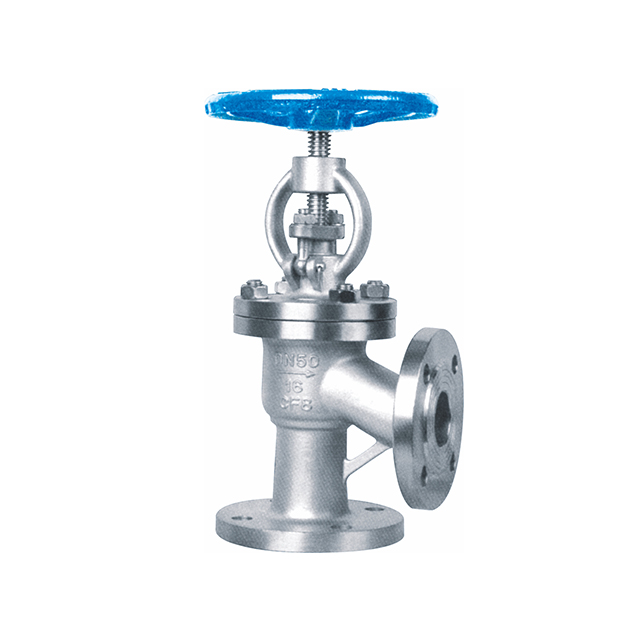
Pressure Drop Comparison: Straight vs. Angle
The internal “tortuosity” of a valve directly correlates to its energy consumption. Because a straight-pattern valve forces the fluid through a complex series of turns, it generates high turbulence. This results in a higher pressure drop across the valve, meaning the system’s pumps must work harder to maintain flow.
The angle globe valve offers a significantly more “streamlined” internal geometry. Since the fluid makes only one right-angle turn before exiting, the resistance is halved compared to many Z-body designs. This lower pressure drop is particularly valuable in high-velocity steam service. By reducing turbulence, the angle type globe valve also experiences less “scouring” and erosion on the disc and seat faces, which is a primary concern for those maintaining industrial globe valves in abrasive or high-temperature media.

Maintenance Accessibility for Each Design
From a maintenance perspective, the two designs offer different ergonomic challenges. Straight-pattern industrial globe valves are ideal for long horizontal runs where the technician has 360-degree access around the pipe. However, in vertical stacks, these valves can become difficult to service.
The angle globe valve is frequently the hero of maintenance accessibility in corner installations. Since the bonnet usually extends outward from the corner, it is easier for a technician to disassemble the stem and disc without bumping into parallel piping runs. This is a major advantage for globe valve suppliers who must guarantee “serviceability” in offshore or modular skid designs.
The primary caveat is ensuring that the stem has sufficient overhead clearance to retract during a packing change. This detail must be verified against the technical datasheet of the angle type globe valve during the design phase.
Which Should Valve Procurement Teams Choose?
While the straight-pattern valve is the traditional workhorse for linear piping, the angle globe valve is a specialized tool that provides superior hydraulic efficiency and spatial economy. By eliminating unnecessary elbows and reducing the internal pressure drop, the angle type globe valve lowers both capital expenditure for the piping run and the operational energy costs of the pumps.
Whether it’s about high-pressure stream lines or compact offshore skids, choosing a valve shape that complements the piping geometry prevents costly replacements in the future. Understanding these shape-based impacts is the key to moving beyond “standard” designs and toward high-performance, optimized piping architecture. The angle pattern’s ability to handle complex layouts makes it a valuable asset for high-efficiency engineering projects.


