
In a city’s water network, the water moves through hundreds of kilometers of pipes. The pipes move from treatment plants to homes, factories, and fire hydrants.
The water system also needs signals and on-ramps to stay orderly. This is where the butterfly valve types come in. The valves control where the water goes and how fast it flows.
This guide discusses what a project engineer or field professional needs to know about the butterfly valve working principle and the different types. It also discusses the butterfly valve advantages and disadvantages, and how different butterfly valve types are used in the water supply system.
What is a Water Treatment Butterfly Valve?
A butterfly valve controls fluid by rotating a flat disc 90 degrees inside a pipe body. It rotates in a quarter turn. Valve closure occurs when the disc is oriented perpendicular to the flow path. To open the valve, the disc is rotated to align parallel with the flow.
The valve’s name comes from the wing-like appearance of the disc as it rotates from its stem. The 90-degree rotation provides rapid actuation for immediate flow isolation
Butterfly valves are recommended for water supply, water distribution, collection systems, pumping stations, and water treatment plants. They are defined by compact bodies, low weight, and fast actuation. This makes them the preferred choice for pipes DN 200 (8 inches) and larger.
Butterfly Valve Parts Diagram: Key Components Explained
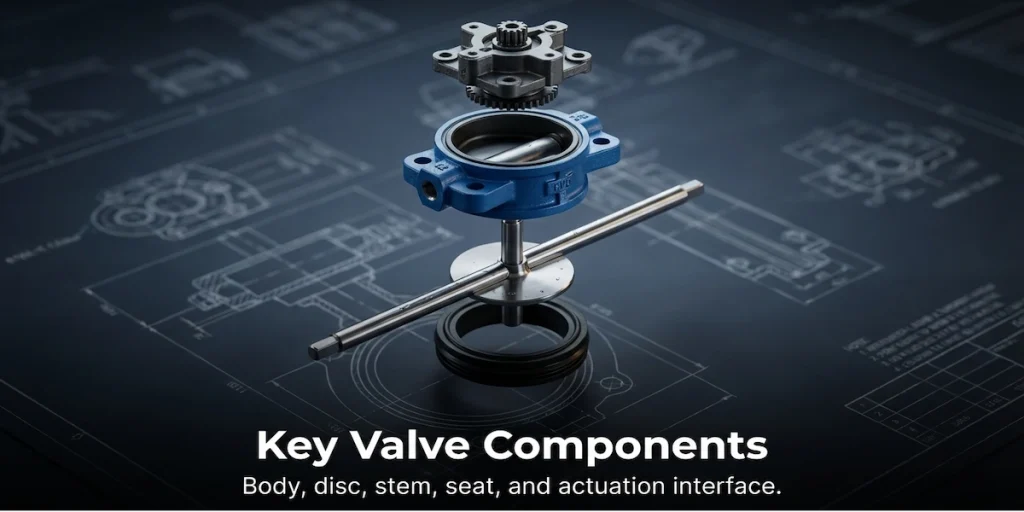
This section discusses the key components that will help buyers specify the correct configuration. Understanding the main parts also helps maintenance crews identify which parts wear out quickly.
1. Valve Body
This is the outer housing that fits between or onto pipe flanges. The standard materials in water service are GGG50 per EN 1563 ductile iron with fusion-bonded epoxy powder coating (minimum 250 microns). The epoxy coating protects against corrosion and prevents potable water contamination.
2. Disc
This rotating element is like a gate that stops or allows flow. In water applications, the disc is typically ductile iron with a continuous 316 stainless steel welded edge. The stainless edge provides a corrosion-resistant sealing surface that resists the abrasive action of flowing water.
3. Stem or Shaft
The stem connects the disc to the handle or external actuator. In a butterfly valve with an actuator, the two-piece stem design allows you to remove the upper shaft for maintenance. Disassembling the entire valve body is unnecessary. The standard material used to prevent corrosion is 316 stainless steel.
4. Seat
The seat is the primary leak prevention point. It is the internal seal where the disc presses against when the valve closes. Common seat materials include EPDM, PTFE, and NBR rubber. These depend on different water types.
5. Seals and O-Rings
Multiple O-rings seal the stem where it exits the valve body. This prevents leakage along the shaft. Modern designs use stacked O-ring configurations. If one seal degrades, the others maintain pressure integrity until the next scheduled maintenance.
6. Actuation Interface
The top of the stem is connected to a lever, handwheel, gearbox, or actuator. The flanges are mounted according to ISO 5210 (multi-turn actuator mounting) or ISO 5211 (quarter-turn actuator mounting).
Butterfly Valve Working Principle
How does the butterfly valve work? Its working principle is straightforward. The disc sits inside the pipe, mounted on a central stem.
In a closed position, it creates a seal when the disc sits perpendicular to the fluid flow and presses against the seat.
In an open position, the actuator rotates the stem 90 degrees, and the disc rotates with it. The disc aligns parallel to the flow direction. Water can now flow freely around the thin edge of the disc.
In a partial rotation, between 0 and 90 degrees, it also allows full throttling. The relationship between disc angle and flow rate follows either of these patterns:
- ·Near-Linear Flow – shows the disc position corresponding directly to flow rate. At 60% open, approximately 60% of maximum flow passes through. This is common in double eccentric designs.
- Quick-opening Flow – shows a rapid increase in flow in the first 30 to 40 degrees of opening. Smaller additional movement provides less change at higher angles. This is common in standard concentric designs.
Choosing the Right Butterfly Valve Types for your Project
Different valve types perform differently. The correct type depends on the following:
- Pipe size
- Operating pressure
- Shut-off class requirement
- Frequency of valve operation
Below is a table that summarizes the different valve types, their specifications, and applications:
| Feature | Concentric | Double Eccentric | Triple Eccentric |
| Seat wear | Higher | Lower | Minimal |
| Operating torque | Higher | Lower | Lowest |
| Max pressure | PN 10 (145 psi) | PN 16 (232 psi) | PN 40 (580 psi) |
| Shut-off class | Class IV–V | Class V–VI | Class VI / EN 12266-A |
| Typical size range | DN 50–600 | DN 150–1600 | DN 150–2500 |
| Typical use | Irrigation, low-pressure | City water mains | High-pressure, critical |
Water Treatment Butterfly Valve Installation: Connection and Actuation Methods

Choosing the right connection style is vital for water treatment butterfly valve installation and future maintenance.
- Wafer Style: This style fits between pipe flanges. It is the most compact and cost-effective. However, it is not suitable for dead-end service.
- Lug Style: This style features threaded lugs. It allows one side of the pipeline to be disconnected without disturbing the other. This is ideal for maintenance-friendly setups.
- Double Flanged: This style includes its own flanges. It also provides the strongest connection for large-diameter pipes (24 inches and above).
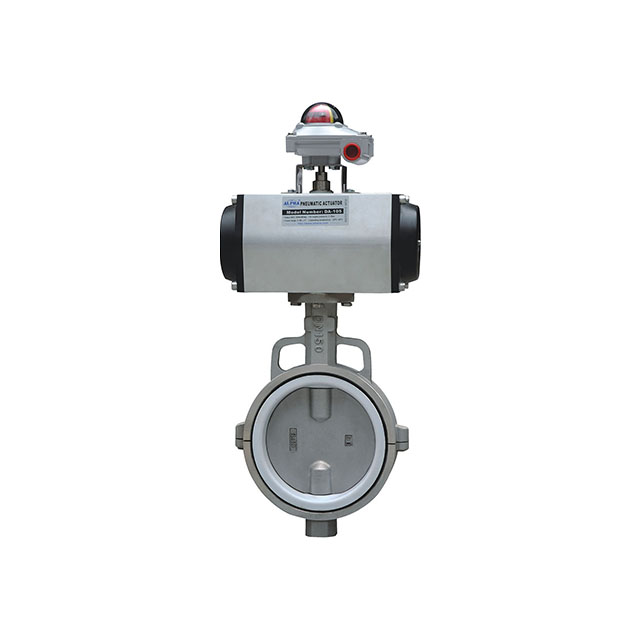
For automated systems, a butterfly valve with an actuator is often required. You may choose from electric actuators for SCADA integration, pneumatic actuators for rapid response, or hydraulic actuators for very high-torque applications.
Where Is a Water Treatment Butterfly Valve Used in Water Supply?
The water treatment flow control valve appears at every stage of a modern water network.
The table below summarizes the specific valve types, specifications, and where they are commonly used:
| Application Sector | Specific Use Case | Typical Valve Size & Type | Key Technical Requirements |
| Municipal Mains | Transmission and distribution isolation | DN 600 – DN 2500; Double or Triple Eccentric | High pressure ratings (PN 16–PN 25); Gearbox-operated manual handwheels. |
| Water Treatment Plants | Raw water intake, filter backwash, chemical dosing | DN 50 – DN 2000; Concentric or Double Eccentric | PTFE seats for chemicals; Electric actuators for automated backwash cycles. |
| Pumping Stations | Pump suction/discharge isolation; flow bypass | Various; Double Eccentric | AWWA C504-compliant seats; Fail-safe spring-return actuators for emergencies. |
| Reservoirs & Storage | Inlet/outlet fill and draw cycles; tank isolation | Various; Determined by static head | Pressure class selected based on height (e.g., PN 10 for 30m height). |
| Pressure Management | Zone boundary control (District Metering Areas) | Various; High-performance types | Electric actuators for automatic pressure balancing and surge prevention. |
| Fire Protection | High-pressure ratings (PN 16–PN 25); Gearbox-operated manual handwheels. | NFPA 13 Compliant | Must include locking mechanisms or tamper switches for position monitoring. |
| Wastewater Treatment | Influent isolation, aeration basins, effluent control | Reinforced seat designs | Harder durometer rubber and anti-corrosive epoxy/polyurethane coatings. |
| Industrial Process | Cooling towers, manufacturing process water | Various; Stainless steel body options | Chemical-resistant seat materials like PTFE or FKM for aggressive chemistry. |
Butterfly Valve Advantages and Disadvantages
When evaluating the butterfly valve advantages and disadvantages, the benefits for large-scale water projects are clear:
Advantages
- Its compact design takes up approximately one-third the space of a gate valve.
- At sizes DN 200 and above, they are cost-efficient because they cost 30 to 50% less than gate valves.
- Minimal obstruction reduces pump energy costs and ensures low pressure drop.
Disadvantages
- The disc remains in the flow. This prevents the use of cleaning pigs.
- High-velocity throttling can lead to cavitation risk and disc damage.
Installation and Maintenance Tips
Proper water treatment butterfly valve installation prevents early leaks. During installation and maintenance, pipe flanges should always be cleaned. Before securing the bolts, always check for misalignments. Use a star-pattern tightening sequence to ensure even sealing pressure.
For long-term reliability, perform a water treatment butterfly valve replacement if the seat no longer seals completely. Routine maintenance should include exercising the valves monthly to prevent seizing, especially for emergency isolation units that are rarely used.
Conclusion
Xintai Valves, manufacturer of valves since 1998, offers water treatment butterfly valve units for your water infrastructure project.
Selecting the best water treatment butterfly valve requires choosing materials that meet project-specific pressure ratings like PN 16. This involves specifying components such as ductile iron bodies and EPDM seats to satisfy unique corrosion requirements. You must also choose the correct actuation and connection style for your specific project’s needs.


