

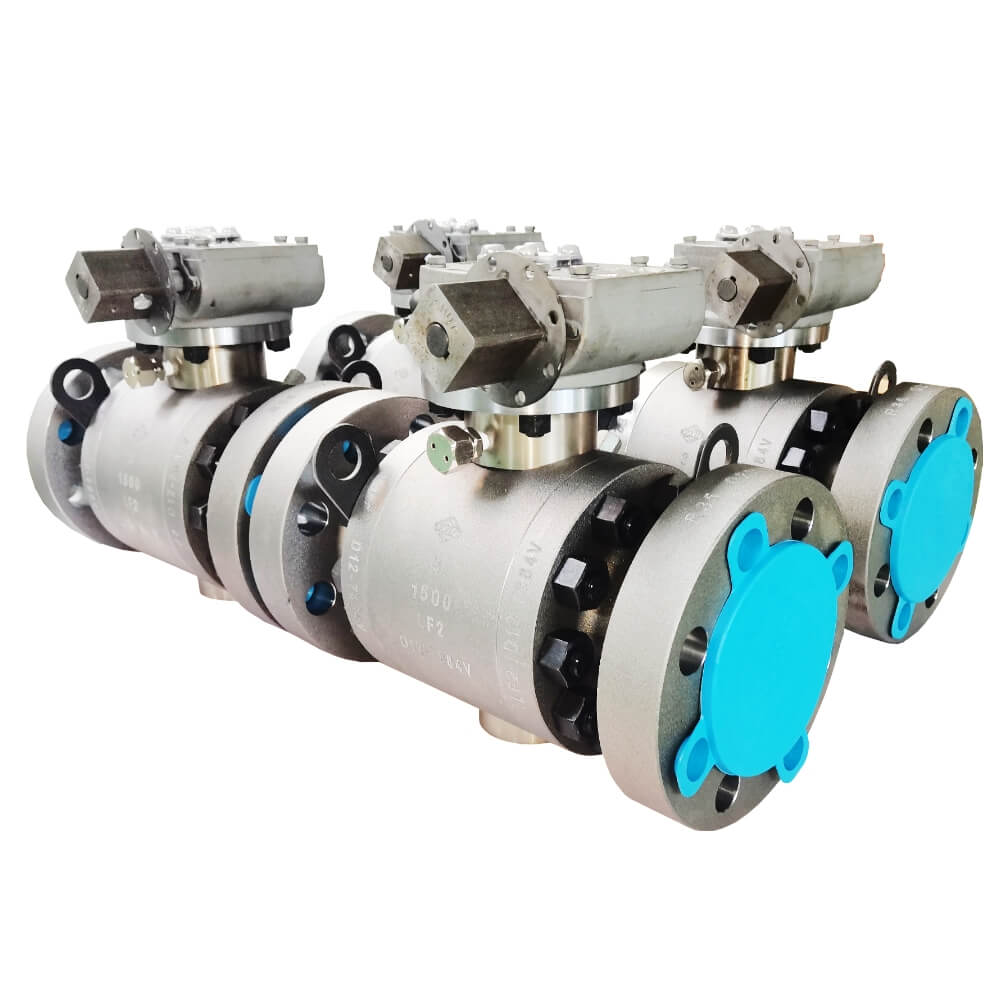


Forged Trunnion Ball Valve
With all advantages of Trunnion Mounted Ball Valves, Vatac Forged Steel Line are available in types of Two Piece Split Body & Three Piece Bolted Body. The forging material can ensure sufficient rigidity and strength under maximum rated operation pressure. Without inherent flaw of cast. Enough wall thickness of separate body and adaptation of high strength tie bolts are convenient for valve maintenance and sufficient to bear the stress of pipe.The internal parts of valve are carefully designed and selected to ensure reliability under all kinds of work conditions.
Description
Trunnion Ball Valve Vs. Floating Ball Valve
When choosing a ball valve for your pump, you have two options. You can choose either a floating ball valve or a trunnion ball valve. Both have their advantages and disadvantages. Floating ball valves are more cost-effective, but both have disadvantages, too.
The floating ball valve has a floating ball that is suspended due to tight compression on the valve seats. Workers can rotate the valve 90 degrees to allow or stop a stream. Floating ball valves are perfect for low-pressure applications.
The difference in performance is apparent in the materials used in these valves. While the floating ball valve uses a ball as a seal, the trunnion ball valve relies on the pressure in the line to prevent leakage. The trunnion ball valve’s metallic seating surface prevents leaks, and it is fire-safe.
If you want to know more about trunnion ball valve vs. floating ball valve, continue reading this article.
What is Trunnion Ball Valve?
These valves are commonly used in the oil and gas industry for a variety of applications. When used in these applications, they are ideal for high-pressure, high-temperature, and corrosive liquids. A trunnion ball valve works by inserting a sphere-shaped ball into a central bottom shaft.
The ball rotates in this direction against the trunnion, which is referred to as the trunnion. The actuator rotates the stem, which in turn turns the ball. A trunnion ball valve can be used in viscous fluids or suspensions with tiny solid particles.
Trunnion valves require less torque to turn than floating ball valves. Unlike floating ball valves, trunnion ball valves have a higher price tag. A key factor in determining which type of Trunnion Ball Valve is right for your application is the type of packing. It is important to select a valve with a spring-loaded packing to compensate for the inevitable wear and tear of the stem seal.
What is a Floating Ball Valve?
Floating ball valves are widely used in various applications. Besides the obvious applications, they can be used in many harsh environments and high temperatures. When choosing a floating ball valve, you should also consider its two-piece design and type of sealing.
This type of valve is designed to prevent backflow by allowing the flow of fluids through it. Its stem is connected to a slot on the ball’s top. The ball rotates laterally in response to upstream pressure, and the stem connects it to the ball. The ball’s lateral movement is regulated by seals on the stem and seats to prevent leakage. Floating ball valves are capable of bi-directional shut-off, but they’re difficult to operate when pressure is high upstream.
Trunnion Ball Valves Vs. Floating Ball Valves – Which is the Better Choice?
There are several factors to consider when choosing the best valve type for your needs. If you need to operate at high pressures, you should consider the size of the stem. A bigger stem diameter means a bigger valve body, which is expensive. You should also consider reducing operating torque. Trunnion ball valves and floating ball valves can lower the sealing force, but you should also take into account the cost of the operation.
If you’re looking for the best ball valve for your application, you should look for a design that has anti-static and anti-blowout stems. These features help prevent leaks due to high pressures. Additionally, a flexible soft seat is a must-have feature for any floating ball valve. The floating ball valve can be used for low-pressure applications.
A trunnion ball valve is a more stable choice when considering the size of the valve. A trunnion design features a fixed valve core and a movable sealing seat, which makes them much more stable while working. In addition, they have self-cleaning capabilities and automatic compensation. Trunnion ball valves are best for the on-off operation of fibers, suspensions containing tiny solid particles, and viscous fluids.
Floating ball valves are typically used in low-pressure applications, but the costs associated with a trunnion ball valve are higher. If you’re uncertain, talk to a ball valve specialist to find out which type of valve would be best for your needs. The right valve design can help you avoid costly mistakes and maximize your productivity. Just remember: ball valves are not interchangeable!
The trunnion ball valve has numerous advantages, including a fire-safe design. It is less likely to catch fire and prevents environmental pollution. Because of its trunnion design, it is also more likely to resist corrosion and abrasion. These qualities make it the preferred valve type for most applications. They are both reliable and safe. There are some major benefits to choosing a trunnion ball valve over a floating ball valve, but the choice is ultimately up to you.

Related products
BALL VALVE
- 3-Way L Port Ball Valve
- 3-Way T Port Ball Valve
- 4-Way Ball Valve
- Bronze Ball Valve
- Casting Floating Ball Valve
- Casting Trunnion Ball Valve
- Double Block and Bleed Valve
- Flange Type Segment Ball Valve
- Forged Floating Ball Valve
- Forged Trunnion Ball Valve
- Full-Welding Ball Valve
- Metal Sealing Ball Valve
- Soft Sealing Ball Valve
- Thread Ball Valve
- Top Entry Ball Valve
- Undergroud Ball Valve
- V-Notch Valve
- Wafer Type Segment Ball Valve
BUTTERFLY VALVE
- Centerline Wafer Type Butterfly Valve
- Double Eccentric Butterfly Valves
- Triple Eccentric Butterfly Valves
CHECK VALVE
- Bronze Check Valve
- Butt Welding Check Valve
- Forged Check Valve
- Globe Check Valve
- Lift Check Valve
- Swing Check Valve
- Thread Check Valve
- Wafer Check Valve
CONTROL VALVE
- Electric Actuator Ball Valve
- Electric Actuator Butterfly Valve
- Electric Actuator Gate Valve
- Electric Actuator Globe Valve
- Pneumatic Actuator Ball Valve
- Pneumatic Actuator Butterfly Valve
- Pneumatic Actuator Gate Valve
- Pneumatic Actuator Globe Valve
CRYOGENIC VALVE
- Cryogenic Ball Valve
- Cryogenic Check Valve
- Cryogenic Gate Valve
- Cryogenic Globe Valve
GATE VALVE
- Bellow Gate Valve
- Bronze Gate Valve
- Butt Welding Gate Valve
- Casting Wedge Gate Valve
- Forged Wedge Gate Valve
- Knife Gate Valve
- Thread Gate Valve
GLOBE VALVE
- Angle Type Globe Valve
- Bellow Globe Valve
- BS 1873 Globe Valve
- Butt Welding Globe Valve
- Casting Globe Valve
- Forged Globe Valve
- Thread Globe Valve
Plug Valve
- Plug Valve
SAFETY VALVE
- High Performance Steam Safety Valve
- Jacketed Safety Relief Valves
- Pilot Operated Safety Valve
- Spring Load Safety Valve
STRAINER
- Basket Strainer
- Cast Iron Y Strainer
- Thread Y Strainer
- Y Strainer


