
In industrial plants and processing facilities, butterfly valves are deployed for their compact footprint and straightforward operation. The operation is simple. The valve manages fluid flow by rotating a circular disc within the pipe bore.
So, how does a butterfly valve work in a real-world application?
When an operator turns the stem 90 degrees, the disc rotates to a perpendicular position to block the flow. Rotating it back to zero degrees or parallel to the flow returns it to a fully open position.
This rapid quarter-turn action allows the operator to stop, start, or throttle flow. Butterfly valves can be used across various media such as water, steam, oil, and chemical lines.
To help you select the right hardware for your system, this guide explores the core operating principles, essential butterfly valve components, design variations, and specific industrial use cases.
Primary Butterfly Valve Components and Functions
As an engineer or industrial operator, it is important to understand the parts of a butterfly valve. This helps streamline maintenance and procurement.
The following section details the essential butterfly valve components and their specific roles in flow control:
- Valve Body: The main structure that fits between pipe flanges. Common styles include wafer, lug, and flanged bodies.
- The Disc: Often referred to as the “butterfly.” This component obstructs the flow.
- The Stem: The shaft connects the internal disc to the external actuator. It must be made of high-strength alloys like SS316 or 17-4 PH to resist torque.
- The Seat: This provides the seal between the disc and the body. Seats can be resilient (rubber/PTFE) or metallic.
- The Actuator: This provides the force to turn the stem, which can be manual, pneumatic, or electric.
These butterfly valve components must meet international standards such as API 609 or ASME B16.34 to ensure safety in industrial plants.
The Basic Principle: How Does a Butterfly Valve Work?

The operating principle is straightforward. That’s why most industrial operators refer to the butterfly valve work video to visualize the process. A metal disc is mounted at the center of the pipe on a stem. The stem connects to an actuator outside the valve body.
1. Closed Position
When closed, the disc sits perpendicular to the pipe bore. The outer rim presses against the seat while compressing the elastomer or engaging the metal cone. No flow passes through. Shutoff integrity depends on disc-to-seat contact force and seat material grade.
2. Open Position
The actuator rotates the stem 90°. The disc now aligns parallel to the flow. Fluid passes around both sides of the disc with minimal restriction. Unlike a gate valve, the disc stays in the flow path, which results in a residual pressure drop.
Cv values (flow coefficients) for a fully open butterfly valve range from approximately 35 to 75 per inch of nominal pipe diameter. This depends on the disc profile and valve type.
3. Throttling / Flow Regulation
Unlike a ball valve, the butterfly valve can open in stages. The disc angle determines the flow rate. In this way, the valve doesn’t release water in a simple, steady way as you open it. It starts with small, precise amounts and increases significantly as you reach the fully open position.
For accurate sizing, use the manufacturer’s Kv/Cv tables or consult IEC 60534-2-1 for control valve flow calculations.
Three Main Butterfly Valve Design Types

All three designs operate on the quarter-turn principle. The differences lie in disc geometry, stem offset, and sealing mechanism.
The table below summarizes the key differences in pressure rating, temperature capability, seat life, and torque:
| Parameter | Concentric (Zero-Offset) | Double Offset | Triple Offset |
| Max. Pressure | ~17 bar (250 PSI) | ~100 bar (1,440 PSI) | ~102 bar (1,480 PSI) |
| Max. Temperature | ~200 °C | ~650 °C | ~650 °C |
| Seat Material | Rubber (EPDM / NBR / FKM) | Rubber or metal | Metal (laminated or solid) |
| Leakage Class | EN 12266-1 Class B | Class A or B | Class A (zero-leakage) |
| Flow Direction | Bidirectional | Preferred direction | Unidirectional only |
| Typical Standards | AWWA C504, EN 593 | API 609 Cat. A | API 609 Cat. B, EN 593 |
The following section explores the highlights of each valve type.
Concentric (Zero-Offset) Butterfly Valve
A concentric butterfly valve has a stem that runs through the exact center of the disc. The disc edge contacts the rubber seat across its full circumference during every open and close cycle. This constant rubbing limits seat life in high-cycle or abrasive service.
As a result, the concentric design is a cost-effective choice for low-pressure water supply and general fluid control. However, they are only recommended for pressures below 16 bar (psi).
Concentric or zero-offset valves are made of ductile iron GGG50 with epoxy coating, or stainless steel 316 for corrosive media.
Potable water systems require rubber-seated butterfly valves to comply with AWWA C504 standards.
Double Offset (High-Performance) Butterfly Valve
The double offset design creates a cam-like closing action. The disc lifts away from the seat during the first 10 degrees of opening. Then, it returns to full seat contact only in the final 10 degrees of closing. There is no seat contact during the movement.
This results in lower operating torque and extended seat life, which makes it suitable for steam, oil & gas, and high-pressure water lines.
However, it is crucial to follow the manufacturer’s recommended flow direction to preserve sealing performance.
Double Offset Valves require API 609 Category A and ASME Pressure Class 150 to 600 (PN 10 to PN 100).
How Does a Triple Offset Butterfly Valve Work?
The triple offset design adds a third geometric offset: a conical sealing surface on the disc and seat.
The three offsets work together:
- Offset 1: stem axis behind disc centerline
- Offset 2: stem axis away from bore centerline
- Offset 3: disc seat contact axis tilted to a right-angle cone — creating a non-rubbing, frictionless seal
The cone geometry means the disc and seat make contact only at the final point of closure. There is zero sliding friction throughout the travel arc. This eliminates seat wear entirely.
In the forward (preferred) flow direction, line pressure acts as a self-energizing force: higher pressure increases seating force, tightening the shutoff. Reverse installation negates this effect and reduces the seat contact force.
Metal-to-metal sealing achieves EN 12266-1 Class A (zero-leakage) and meets API 598 testing. Triple offset valves are specified in:
- Power generation, such as steam turbine bypass lines, boiler feed systems (operating at 540 °C / 1,000 °F)
- Refinery & petrochemical with hydrocarbon isolation, fire-safe service per API 607
- LNG terminals with cryogenic service down to −196 °C
- High-temperature steam with pressure class ASME 600 to 2500
You may also ask, how does a butterfly valve slide work? In reality, a butterfly valve doesn’t actually “slide” like a gate valve. The sliding or sweeping motion is characterized by the movement from open to closed.
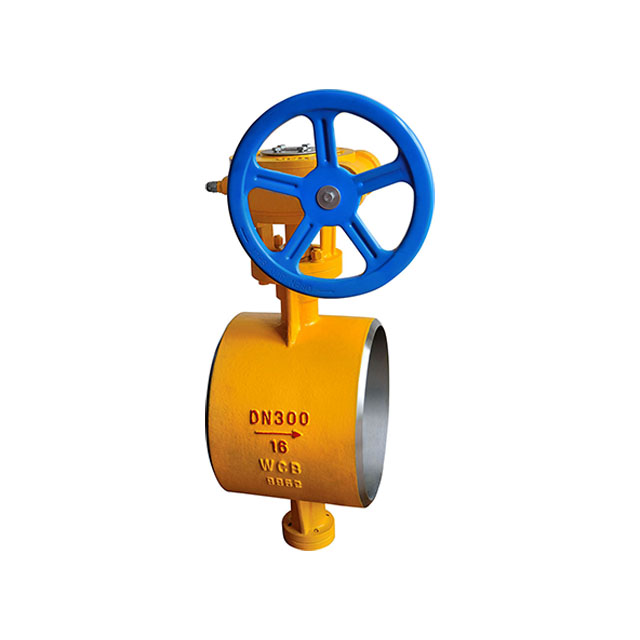
Pressure: CL150 (PN6~PN25)
Connect Type: FLG
Standard: ASME B16.34 / API-609
Industrial Applications by Valve Type
| Industry | Typical Service | Recommended Type |
| Water & Wastewater | Flow isolation, DN80–DN2000 mains | Concentric, AWWA C504 |
| Oil & Gas | Process lines, fire-safe isolation | Double offset, API 609 Cat. A |
| Refinery / Petrochemical | Hydrocarbon isolation, high-temp steam | Triple offset, API 609 Cat. B / API 607 |
| Power Generation | Turbine bypass, boiler feed at >540 °C | Triple offset, ASME Class 600–2500 |
| Food & Beverage | Hygienic media, CIP-compatible lines | Concentric, 316 SS body, NSF/ANSI 61 |
| Mining / Slurry | Abrasive slurry, high-cycle isolation | Slide-action or double offset, lined disc |
Conclusion
A butterfly valve is the standard choice for rapid shutoff in most industrial piping systems. The valve controls flow by rotating a disc through 90° inside a pipe bore. This quarter-turn action is critical, especially in emergency shutoff situations.
There are three primary designs of butterfly valves: concentric, double offset, and triple offset. Each valve covers pressure classes from PN10 to PN250 and temperatures from −196 °C to 650 °C. It is important to understand the butterfly valve components to help you choose the right one for your project.
Xintai Valve manufactures concentric, double offset, and triple offset butterfly valves to API 609, EN 593, AWWA C504, and ISO 5752 standards. Contact the engineering team for application-specific sizing, material selection, and actuator torque calculations.


