
The double flanged butterfly valve is often the solution for large-diameter pipelines. A valve for a DN400 water treatment pipeline must hold PN16 pressure. The valves should also bolt cleanly to existing pipe flanges on both sides and last for decades with minimal maintenance.
Large-diameter pipelines require flow control solutions that maintain structural integrity even under high pressure. Maintenance teams often face challenges when installing valves in industrial environments.
The double flanged valve solves this problem by bolting directly to pipe flanges on both sides. This creates a structurally self-sufficient connection. For a DN400 water treatment line at PN16 pressure, this design ensures a leak-free seal and simplifies long-term maintenance.
This article discusses the technical specifications, components, and selection criteria for the double flanged type valve.
What is a Double Flanged Valve?
A double flanged valve is characterized by having integral flanges on both ends of the valve body. These flanges contain dedicated bolt holes that align directly with mating pipe flanges.
The difference from wafer valves is that they are “sandwiched” between pipes and held by long bolts. But, double-flanged valves are structurally self-sufficient and bolt directly to each side.
The core mechanism involves a circular disc mounted on a central shaft. You should rotate this shaft a quarter-turn to move the disc to a fully open position.
Consequently, a single flange butterfly valve features flanges on only one side. This is ideal for specific space-saving or end-of-line requirements. With the double-flanged version, it “grips” the pipeline from both directions.
The double flange design provides superior stability in large-bore systems where vibration or mechanical stress is a factor.
Key Components and Material Options

Double flanged butterfly valve manufacturers use heavy-duty materials customized for specific media.
Understanding each component is essential to correctly specifying the right valve for medium, pressure, and temperature conditions.
Its primary components include:
- Body: Constructed from ductile iron (GGG40/50), cast iron, or carbon steel. Valve bodies are often coated with fusion-bonded epoxy for corrosion resistance.
- Disc: The disc must be compatible with the process medium. Standard materials include SS304, SS316, or aluminum bronze.
- Liner/Seat: EPDM is the standard seal for potable water and seawater. NBR is recommended for oils, while Viton or PTFE are for high-temperature chemicals or steam.
- Shaft/Stem: A high-tensile stainless steel shaft connects the disc to the actuator.
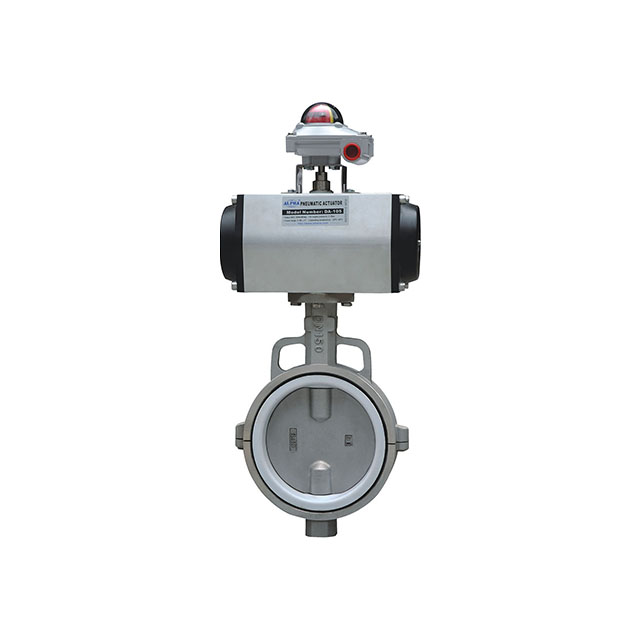
- Actuator Mounting: Double flanged butterfly valve manufacturers include an ISO 5211 top-flange drilling. This allows for direct mounting of manual handwheels, gearboxes, electric actuators or pneumatic actuators without adapter brackets.
Double Flanged Valve: Sizes and Dimensions
Engineers should refer to the double flanged butterfly valve dimensions chart to check for compatibility. The standard range of double flanged butterfly valve sizes is from DN40 to DN1200. However, specialized factories produce units that exceed DN2000 for municipal water mains.
Pressure ratings normally follow PN6, PN10, or PN16 standards. For example, smaller diameters up to DN200 use PN16. Larger units normally operate at PN10 to balance weight and cost.
Temperature capabilities depend on the liner. EPDM operates between -30°C and 110°C, while Viton can operate up to 200°C.
Buyers should download a double flanged butterfly valve PDF or consult a double flanged butterfly valve catalogue before procurement. This helps verify face-to-face lengths according to EN558-1 Series 13 or JIS F7480 standards.
Installation Guide to Double Flanged Butterfly Valve Bolting
The installation process is straightforward because the valve body acts as a rigid bridge between pipes.
To install the valve, the double flanged butterfly valve bolting uses separate sets of nuts and bolts. This secures the valve to each side of the pipe flanges and prevents pipes from disconnecting.
Technicians must tighten bolts in a star or cross-pattern for a leak-free seal and even compression of the gaskets. Since the valve follows international face-to-face standards, it can be retrofitted into existing layouts without modifying the surrounding pipework.
Always verify the bolt circle diameter (BCD) against your mating flanges before the valve arrives on-site.
Industries and Applications: Where These Valves Do the Work

Double flanged valves are the workhorses of heavy infrastructure. Their primary applications include:
- Water Treatment: EPDM-lined valves are standard for potable water and sewage.
- Marine & Offshore: NBR-lined versions are used for seawater cooling and ballast systems, often carrying DNV or Lloyd’s certifications.
- Power & Mining: Gear-operated valves manage large amounts of cooling water and transport thick slurries.
Bray double flanged butterfly valves are a well-recognized brand in the sector. But many procurement managers evaluate multiple double-flanged butterfly valve manufacturers. This helps them to compare material traceability and specific ISO 9001 quality standards for their project needs.
What are the Advantages of a Double Flanged Butterfly Valve?
Double flanged valves offer several advantages for industrial applications as compared to single flange butterfly valve types (wafer or lug). Their design enhances ease of use and structural integrity in plumbing systems and pipelines.
Here are the reasons why:
The dual flange design is ideal for large-diameter pipelines (DN300+), high-pressure systems, and areas prone to vibration.
The quick quarter-turn opening and closing allow efficient flow control, especially in emergency shutoff scenarios. It also allows for zero-leakage sealing even in demanding media such as corrosive or abrasive fluids.
Lastly, double flanged valves are made from corrosion-resistant materials such as ductile iron or stainless steel. These materials contribute to a long service life and lower maintenance costs even in harsh chemical environments.
Conclusion
The double flanged butterfly valve provides a solid structure and versatile solution for medium-to-large pipeline systems. Its ability to provide secure, independent bolting makes it an industry standard for water, marine, and industrial processing.
This valve type emerges as the preferred solution for demanding applications. The valve ensures a stable, leak-free connection through its double bolt design.
Xintai Valve manufactures butterfly valves across the full range of industrial requirements. We offer wafer, double eccentric, and triple eccentric types.
Our production is centralized in a 30,800 square-meter state-of-the-art facility, specifically designed to handle large-scale industrial valve fabrication.
To ensure consistent lead times for high-volume B2B orders, we operate 10 dedicated casting and precision manufacturing lines, exclusively for high-performance valves.


