
A gear operated gate valve uses a mechanical gearbox to multiply torque, letting a single operator open or close large or high-pressure valves without excessive effort. These valves handle on/off isolation service only.

How Does a Gear Operated Gate Valve Work?
The operator turns a small handwheel, which drives a gear system inside the gearbox. That system multiplies the force applied at ratios of 20:1 or 40:1. The amplified output transfers directly to the valve stem.
Think of it like a bicycle in low gear. Less effort goes in, more force comes out, and everything moves more slowly as a result.
The stem raises or lowers the wedge slowly and with full control. In high-pressure pipelines, that controlled pace prevents water hammer, the pressure shock that cracks pipes and damages connected equipment.
Most gearboxes include a position indicator on the housing, showing open or closed status at a glance. On underground or confined installations where the stem is out of sight, that indicator is the only way to confirm valve position with confidence.
The operating principle is covered in more depth in our gear-operated valve guide, which walks through how torque multiplication translates to gate movement.
What Is the Difference Between Worm Gear vs Valve Bevel Gearbox?
Two gearbox types are common in industrial gate valve applications. The right one depends on installation layout and torque requirements.
A worm gearbox is self-locking, meaning the gate holds its position under pressure without drifting. On high-pressure lines, that matters because differential pressure alone can shift an unsecured gate.
A valve bevel gearbox changes the input direction by 90 degrees, allowing the handwheel to face sideways or upward instead of straight up. This helps in tight spaces or on vertical pipe runs where a standard orientation is not workable.
Bevel gears run at 93 to 97 percent efficiency. They suit rising stem gate valves where thrust efficiency matters alongside torque.
Higher gear ratios reduce manual effort but require more turns to open or close. On installations where the valve needs to respond quickly, that slower operation needs to be part of the specification.
Key differences between the two:
- Worm gearboxes are self-locking and hold position without a brake
- Bevel gearboxes allow 90-degree handwheel repositioning for tight or underground installations
- Bevel gears run at higher efficiency, typically 93 to 97 percent, versus 50 to 90 percent for worm designs
- Worm gearboxes are the default for most above-ground applications
When to Use a Gate Valve with a Gearbox
Manual operation becomes unsafe or impractical above DN200, which is roughly 8 inches in pipe diameter. A gate valve with a gearbox is necessary from that point upward.
Situations that call for gear operation:
- Valves DN350, roughly 14 inches, and above, where the gate is too large to move by hand safely
- High-pressure pipelines, where the differential pressure across the gate makes manual turning impossible
- Underground or confined spaces where the bevel gearbox lets the handwheel face a different direction
- Systems where slow, controlled opening is needed to prevent water hammer
- High-temperature pipelines, where heat causes the wedge to expand and stick, increasing the force needed to open it
In high-pressure applications, opening torque can run 30 percent higher than closing torque. The gearbox must be rated for that figure, not the average operating load.
Valve Torque Expert
Precision Gearbox Sizing & Estimation ToolWhat Is an AVK Gate Valve?
The AVK gate valve is widely used in water and wastewater systems. AVK valves use rubber-coated wedges for a tight seal, stainless steel stems, and mounting plates that accept standard ISO flange connections. ISO flanges are standardized attachment points that allow gearboxes and actuators to fit without custom fabrication. Common sizes include F10, F14, and F16.
On larger AVK valves above DN350, the higher opening torque needs to be factored into gearbox selection. The keyed stem design allows the gear operator to be swapped out without pulling the valve from the pipeline.
Our bronze gate valve is built to API 600, the American Petroleum Institute standard for industrial gate valve design and testing. It uses aluminum bronze construction and suits the same water and wastewater applications where AVK designs are commonly used, covering service in the Class 150 to 300 pressure range.

Replacement Gate Valve with Gearbox
Sourcing a replacement gate valve with gearbox involves more than matching the pipe size. A few things need to be confirmed before the order goes in.
The gearbox must handle the maximum break torque, the force needed to unseat the wedge after a long closure period. Break torque runs higher than normal operating torque, and gear ratio selection needs to be based on that figure.
ISO flange sizes F10, F14, and F16 are common but not interchangeable. Confirming the correct size before ordering prevents a mismatch that stops the gearbox from fitting the existing stem.
For outdoor, underground, or coastal installations:
- IP65 protects against dust and water splashing, suitable for above-ground exposed service
- IP67 is needed where the valve may be submerged periodically
- Ductile iron or stainless steel housings handle coastal or chemically aggressive conditions better than standard cast iron
Many valve designs accept a replacement gear operator without changing the valve body. Checking whether a standalone gearbox kit fits the existing stem and ISO flange can save a high cost compared to a full valve replacement.
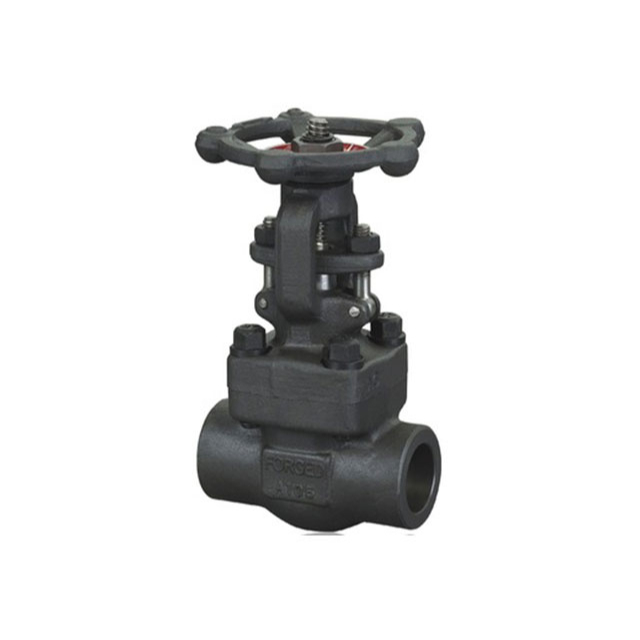
For high-pressure forged steel replacements across Class 150 to Class 2500, our forged steel gate valve covers ASTM A105, F316, and F11/F22 alloy material options. It is built to API 602, the standard for forged steel small-bore gate valves, and ASME B16.34, which governs pressure and temperature ratings for industrial valves. Gear, pneumatic, and electric actuator options are available.
What People Get Wrong About Gear Operated Gate Valves
A few mistakes come up consistently in gear-operated gate valve applications:
- Using the valve for throttling. Leaving the gate partially open causes vibration and wears out the seat quickly
- Skipping gearbox lubrication. The valve body may need no maintenance, but the gearbox needs grease periodically
- Missing the backseat and thread release steps. At full open, turning back a half turn isolates the packing from pressure. A quarter turn back releases stress on the stem threads. Both steps are routinely skipped
- Installing the stem horizontally. The stem should point vertically upward to stop debris from settling in the seat
- Assuming clockwise to close. Most industrial gate valves work this way, but always confirm on replacement units
Xintai Gate Valves for Peace of Mind

Customize the perfect valve for your project! Get a quote and explore our custom options.
Xintai Valve Group has manufactured gate valves since 1998, supplying oil and gas, petrochemical, power generation, defense, and water treatment industries across more than 50 countries.
Production runs to 270,000 valves annually across six manufacturing bases. Each facility uses CNC machining centers for precision work on sealing faces and pressure-bearing surfaces.
Automated assembly lines integrate quality checkpoints throughout production. Foundry operations pour molten iron at above 1,500°C for casting integrity.
Every batch ships with a full inspection report covering dimensional checks, pressure testing to API 598, and material verification. An independent inspection company conducts a second check before shipment, separate from the internal quality team.
Certifications cover ISO 9001, ISO 14001, ISO 45001, CE, SIL, API 6D, API 600, API 602, and API 624. Xintai is qualified by Petronas and Petrobras through their vendor approval processes, and has supplied projects for Saudi Aramco, PARCO, Repsol YPF, and the AMK District Cooling Plant in Singapore.
If you are specifying a gate valve with gear actuation or need help sizing a replacement unit, get in touch with our team, and we will work through the specification with you.


