
A wedge gate valve is a multi-turn isolation valve that uses a tapered gate to slice through fluids and seal tightly against two inclined seats.
If you need a valve that provides a drop-tight shut-off in high-pressure steam or water lines without restricting flow when open, this is your industrial workhorse.
Unlike parallel slide valves that rely solely on line pressure to seal, a wedge gate valve uses the mechanical force of the stem to drive the wedge down, ensuring a positive seal even in low-pressure systems.
To deepen your understanding of which type suits your needs, review the detailed explanation of how wedge gate valves operate and how the mechanical design influences performance characteristics.
This guide breaks down the specific wedge designs, material choices, and operational tricks to help you select the right valve for your facility.
What is a Wedge Gate Valve?
Beyond type selection, your choice should also account for material considerations for gate valve selection to ensure the valve performs reliably throughout its service life in your specific application.
At its core, a wedge gate valve is designed for one purpose: to stop or start flow.
It is not a control valve.

Using it to throttle fluid is a recipe for disaster because the high-velocity flow will erode the bottom of the wedge in a phenomenon called “wire drawing.”
The “wedge” name comes from the shape of the closure element.
Instead of being flat like a plate, the gate faces are angled, typically at 5 degrees.
As you turn the handwheel, the stem pushes this wedge down between two matching angled seats in the valve body.
This wedging action creates a high seating load, which is why these valves are so effective at preventing leaks.
They are bidirectional, meaning they can block flow from either direction, making them versatile for complex piping networks in power plants and refineries.
Main Types of Wedge Gate Valves
Not all wedges are created equal. The internal design of the wedge dictates whether your valve will survive a thermal shock or seize up completely.
Solid (Rigid) Wedge
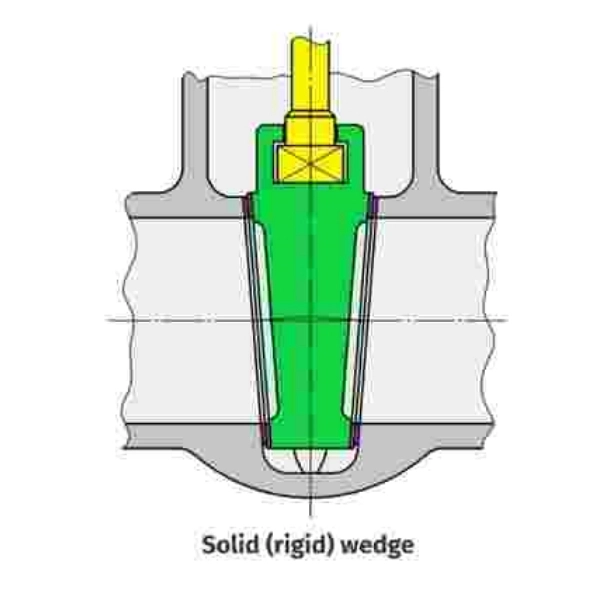
The solid wedge is the most common and robust type. It is a single, solid piece of metal casting.
Because it has no moving parts internally, it is incredibly durable and resists vibration.
It is the default choice for water, air, and oil systems where temperatures remain stable.
However, its rigidity is its Achilles’ heel.
If you use a solid wedge in a high-temperature steam line, the valve might close when hot and then “lock” as it cools down, a problem known as thermal binding.
Flexible Wedge

To solve the thermal binding issue, engineers developed the flexible wedge.
This is still a one-piece construction, but it features a deep groove or cut around the perimeter.
This cut reduces the cross-section, allowing the outer edges of the wedge to flex slightly.
This flexibility allows the wedge to adjust to seat misalignment and, more importantly, to contract slightly without getting stuck when the pipe cools.
For steam systems or any application with thermal cycling, a flexible wedge is mandatory.
Split Wedge
The split wedge consists of two separate discs that can adjust independently.
This self-aligning design is excellent for handling non-condensing gases and corrosive liquids where the valve body might deform slightly under pipe stress.
It is less common than the other two but invaluable in specific chemical applications.
Key Advantages and Limitations
Understanding the trade-offs is crucial for system safety.
Advantages
The primary benefit of a wedge gate valve is its fluid efficiency.
When fully open, the wedge lifts completely out of the flow path, resulting in a minimal pressure drop.
This makes it ideal for pipelines that require “pigging” (cleaning).
The mechanical wedging force also provides a tighter seal at low pressures compared to parallel gate valves, which need high system pressure to push the gate against the seat.
Limitations
These valves are slow to operate.
A large wedge gate valve might require hundreds of turns to close, which is not ideal for emergency shutdown scenarios.
They also require significant vertical space if you choose a rising stem design.
Most importantly, they are prone to seat wear if used for throttling; the turbulent fluid will destroy the seating surface rapidly.
How to Choose the Right Wedge Gate Valve
Selecting the correct valve involves more than just matching pipe size. You must align the wedge type and materials with your process conditions.
Match Wedge to Temperature
If your system operates below 250°F (121°C), a solid wedge is cost-effective and reliable.
For anything hotter, especially steam lines in a power plant, specify a flexible wedge to prevent locking.
Gate Valve Wedge Material Selection
The gate valve wedge material must resist both corrosion and wear.
For standard water and oil, Carbon Steel (WCB) is the industry standard.
However, the seating surface needs to be harder than the wedge to prevent galling.
Look for wedges with “Stellite” (a cobalt-chromium alloy) hard-facing on the seats.
For corrosive environments, switching to a Stainless Steel (CF8M) wedge prevents rust from fusing the wedge to the seats during long periods of inactivity.
Stem and Bonnet Considerations
For corrosive fluids, always choose an Outside Screw and Yoke (OS&Y) design.
This keeps the stem threads outside the fluid, preventing them from corroding.
If you have limited vertical space, a non-rising stem is an option, but be aware that the threads are exposed to the process fluid.
Preventing Failure: Thermal Binding & Pressure Locking
One unique challenge with these valves is “pressure locking.”
This happens when liquid gets trapped in the bonnet cavity (the space above the wedge) and expands due to heat, preventing the valve from opening.
To prevent this in volatile applications:
- Drill a Relief Hole: Ask the manufacturer to drill a small pressure equalization hole in the upstream side of the wedge.
- External Bypass: Install a small bypass line to equalize pressure between the bonnet and the pipe.
- Warm-up Procedures: Avoiding closing the valve tight immediately after a hot run can help, but engineering controls like flexible wedges are safer.

Customize the perfect valve for your project! Get a quote and explore our custom options.


