
A cryogenic gate valve is a specialized industrial valve built for extreme low-temperature service, operating reliably down to -196°C and below. Standard valves fail in these conditions because the metal becomes brittle, and thermal contraction causes seals to leak.

What Makes Cryogenic Service Different from Standard Valve Applications
Most industrial valves are designed for moderate temperature ranges. At cryogenic temperatures, carbon steel loses ductility, elastomeric seals shrink and crack, and stems freeze in place.
The cryogenic valve was developed specifically to solve these problems, with every design element addressing a failure mode that standard hardware cannot handle.
Five Design Features That Make a Cryogenic Gate Valve Work
Cryogenic gate valve design is built around keeping the operating mechanism functional at temperatures that disable standard valves. Each feature below exists for a specific engineering reason.
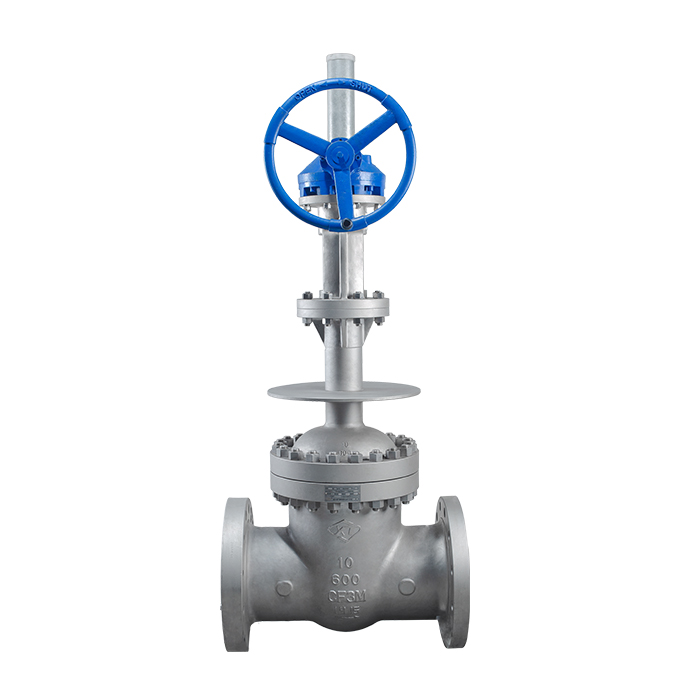
Extended Bonnet Gate Valve
The extended bonnet raises the stem packing well above the cryogenic liquid level, creating a vapor space that keeps the seal warm enough to function.
Without this extension, atmospheric moisture freezes around the packing and locks the stem in place.
Material Selection
Carbon steel becomes brittle below -29°C, which rules it out for cryogenic service. A stainless gate valve built from 304, 304L, or 316L retains ductility down to -196°C and is the default grade for cryogenic gate valve bodies and bonnets.
Titanium alloy and C95800 aluminum bronze are available where stainless grades fall short of the application requirements.
Wedge Gate Design and Seating
The wedge gate valve configuration presses metal against metal at the seating interface. Seats and wedge faces are typically hard-faced with Stellite to resist galling under repeated thermal cycling.
This produces a bubble-tight seal that soft-seat designs cannot sustain at cryogenic temperatures.
Cavity Pressure Relief
When the valve closes, trapped liquid in the bonnet cavity warms slightly and evaporates. Without relief, the resulting pressure buildup can rupture the bonnet.
A small relief hole in the wedge or self-relieving seats vents the cavity automatically before pressure reaches a dangerous level.
Fire-Safe Design
LNG at -162°C and similar flammable cryogenic media require fire-safe construction to API 607. This ensures the valve maintains a functional seal even if the primary seal is compromised in a fire event.
How the Valve Opens, Closes, and Seals at Extreme Temperatures
Turning the handwheel moves the wedge perpendicular to the flow path. At full open, the wedge retracts completely from the bore, leaving a straight-through passage with minimal pressure drop.
At full closed, the wedge presses against both seat faces with metal-to-metal contact. The extended stem keeps the packing assembly in the warmer vapor zone, well above the cryogenic liquid.
Partial opening is not an operating position. It erodes the seat faces and removes the tight shutoff that makes these valves necessary in the first place.
Verify Your Manual Operation Safety
As mentioned, cryogenic temperatures increase friction and material contraction. Before specifying a handwheel size, use our professional estimator below to see if the Break Torque requires a gear operator.
At cryogenic temperatures, material contraction can significantly increase the initial break torque. Use our Cryogenic Torque Estimator below to verify if your current handwheel size provides enough leverage or if a high-ratio gearbox is required for safe manual operation.
Cryogenic Torque Expert
Sizing Verification for -196°C LNG & Sub-zero ServiceIndustries and Applications That Rely on Cryogenic Gate Valves
These valves appear in any process where liquefied gases must be safely controlled at extreme temperatures:
- LNG terminals and storage facilities handle natural gas at -162°C during loading, unloading, and transfer operations
- Air separation plants produce liquid oxygen, liquid nitrogen, and liquid argon at temperatures down to -196°C
- Aerospace and rocket propulsion systems use liquid hydrogen at -254°C alongside liquid oxygen as propellants
- Particle accelerators use liquid helium for superconducting magnets, and hospitals manage large-scale liquid oxygen storage
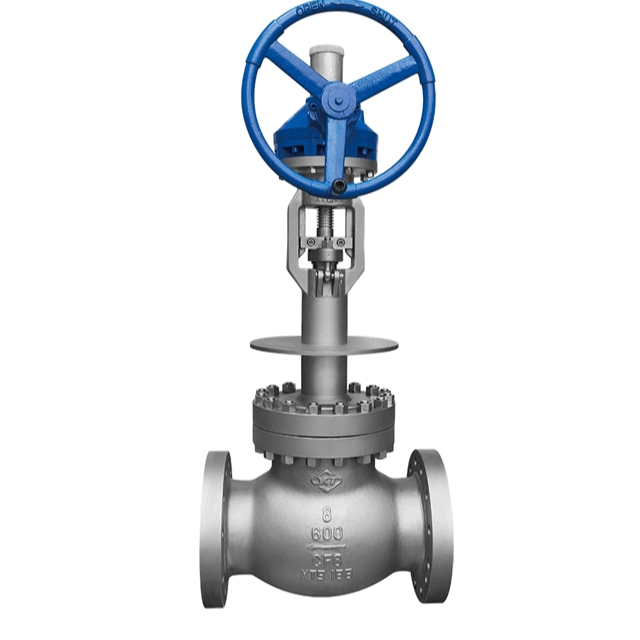
Xintai’s full range of low-temperature valve types for these industries, including ball, check, and globe designs alongside gate valves, is available in our cryogenic valve.
How Cryogenic Gate Valves Compare to Globe, Ball, and High-Pressure Designs
The gate valve is not always the right choice for low-temperature service. Understanding where other types fit helps narrow the selection.
Cryogenic Globe Valves and Flow Regulation
Cryogenic Globe Valves suit throttling and flow regulation better than gate designs. The S-shaped internal flow path gives precise control but creates a higher pressure drop.
For large-diameter isolation duty where straight-through flow matters more than modulation, the gate valve is the stronger option.
Ball Valves and Cold Flow Risk
Ball valves are compact and fast-acting, but soft seats deform permanently under sustained cryogenic pressure, a condition known as cold flow.
Gate valves are preferred at larger diameters where cold flow is a known risk and where the cost of a large-bore ball valve makes the gate design more practical.
High Pressure Gate Valve Designs
A high-pressure gate valve for standard industrial service shares similar gate and wedge geometry but lacks the extended bonnet and cryogenic material grades that low-temperature service requires.
Using a standard high-pressure design in cryogenic conditions causes packing failure and stem seizure, regardless of pressure class.
What to Know Before Installing or Maintaining a Cryogenic Gate Valve
A few things that determine whether the valve performs as specified in service:
- Install with the stem vertical and the extended bonnet pointing upward, since the vapor space only functions in this orientation
- Clean thoroughly before installation. Oil, grease, or particulate contamination is highly reactive in liquid oxygen service and creates an explosion risk
- Butt-welded connections provide better leak security than flanged connections in critical cryogenic lines
- Inspect the packing on a regular schedule. The extended bonnet reduces wear considerably, but does not eliminate it
- Never operate the valve in a partially open position. It destroys the metal seat faces and eliminates the bubble-tight seal
How to Evaluate Cryogenic Gate Valve Manufacturers Before You Order
Cryogenic valve manufacturing requires precise execution at every stage, from material certification and extended bonnet geometry to cleaning and pressure testing.
Gaps in any of these steps show up as leaks or operational failure in service.
Reputable cryogenic gate valve manufacturers produce to BS 6364, MSS SP-134, and ASME B16.34. Designs like Star0044 cryogenic gate valves are specified in critical projects because their testing documentation and construction standards meet the sealing requirements of low-temperature service demands.
For a detailed look at what separates the leading suppliers, our guide to top industrial cryogenic valve manufacturers covers what to verify before placing an order.
Xintai Cryogenic Gate Valves

Customize the perfect valve for your project! Get a quote and explore our custom options.
Cryogenic service leaves no margin for a valve that is almost right. Xintai Valve Group has supplied oil and gas, LNG, petrochemical, power generation, and defense industries since 1998, with projects including Petronas, Petrobras, Saudi Aramco, PARCO, and Repsol YPF across more than 50 countries.
Every cryogenic gate valve leaves the facility with a full inspection report covering dimensional checks, pressure testing to API 598, and material verification.
An independent inspection company runs a second check before shipment, separate from the internal quality team, because cryogenic service tolerates no ambiguity on sealing performance. Certifications cover API No. 6D-1778, ISO 9001:2015, CE, and OHSAS 18001.
Available from DN32 to DN1400 across CL150 through CL2500, with flanged, butt weld, socket weld, and clamp connection options. Materials include 304, 316L, C95800, C63200, and titanium alloy, with options for NACE MR0175 sour service, ISO 15848 fugitive emissions, and Fire Safe API 607.
Full specifications and configuration options are available on our cryogenic gate valve product page.
If you are working through a cryogenic gate valve specification, get in touch with our team, and we will work through the details with you.


